Mexico • July 2, 2026 • Written by: Ongresso - Business Beyond Borders
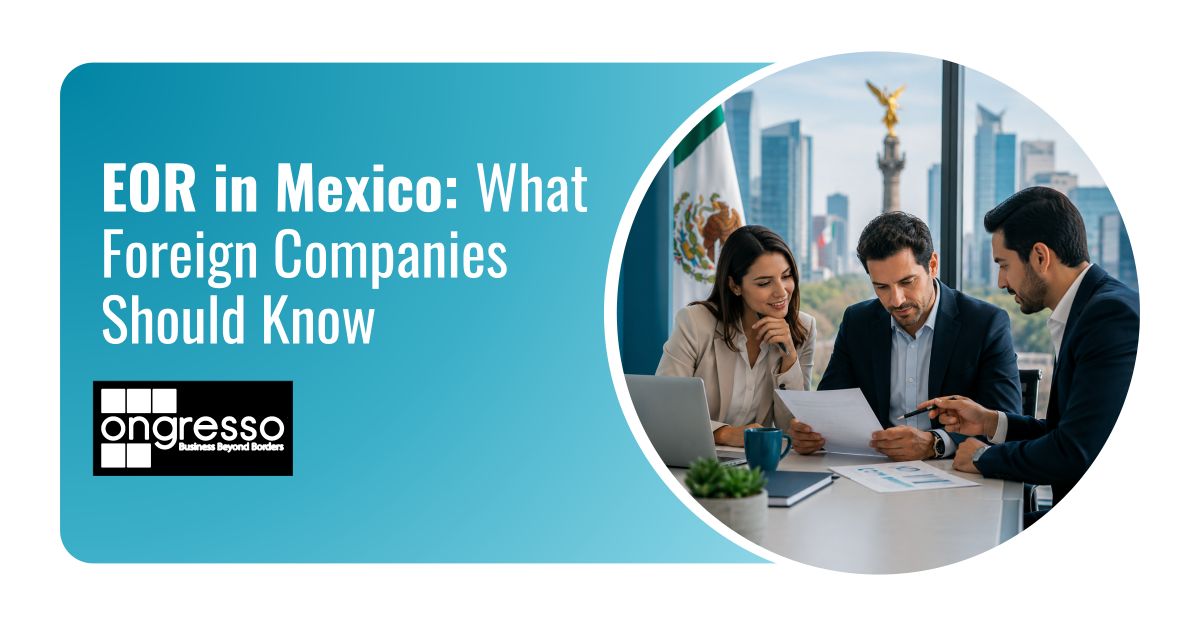
Mexico is one of the most relevant markets in Latin America for companies looking to expand, hire regional talent, or build a commercial presence closer to clients and supply chains. For many foreign companies, EOR in Mexico offers a practical way to hire employees in Mexico without immediately creating a local entity.
At the same time, hiring in Mexico requires careful planning. Labor, payroll, tax, social security, and outsourcing rules must be reviewed before choosing an employment structure. This is especially important in Mexico, where the 2021 labor reform restricted personnel subcontracting and reinforced the need to evaluate how third-party employment models are structured.
What is an EOR in Mexico?
An Employer of Record, or EOR, is a local employment solution that allows a foreign company to engage talent in a country where it does not yet have its own legal entity.
In this model, the EOR acts as the legal employer for the employee in Mexico. The foreign company usually manages the employee’s daily work, role expectations, performance, and business objectives, while the EOR manages employment administration, payroll, labor documentation, statutory benefits, and local compliance.
For companies exploring the Mexican market, an employer of record Mexico solution can be useful when they need to:
- Hire their first local employee.
- Test market demand before incorporating.
- Support a commercial, operational, or technical role.
- Reduce administrative complexity during early expansion.
- Align employment, payroll, and HR processes with local requirements.
Still, EOR should not be treated as a generic shortcut. The structure must be reviewed carefully to confirm whether it fits the employee’s role, the company’s activities, and Mexico’s labor framework.
Why does EOR matter in Latin America?
Latin America is not a single regulatory environment. Each country has its own labor rules, payroll cycles, tax procedures, social security systems, and employment documentation requirements.
Mexico adds an additional layer of complexity because companies must consider not only employment law, but also the rules related to subcontracting and specialized services. Mexico’s labor framework prohibits personnel subcontracting in general terms, while allowing specialized services under defined conditions. For foreign companies, this means the question is not only “Can we hire in Mexico?” but also “What is the right structure for this role, activity, and stage of expansion?”
A poorly structured hiring model can create operational, labor, tax, or reputational risk. A well-planned model helps companies enter the market with more clarity, keep payroll aligned with local rules, and prepare for future growth across the region.
Key aspects companies should consider when using EOR in Mexico
%2011.22.35%20p.m..png?width=914&height=908&name=Captura%20de%20pantalla%202026-07-01%20a%20la(s)%2011.22.35%20p.m..png)
How Ongresso can support
Ongresso supports international companies that need to hire, operate, and remain compliant across Latin America. In Mexico, this means helping companies understand which employment structure fits their current stage, risk profile, and operational needs.
Our approach connects local employment support with broader regional coordination. This includes legal, accounting, tax, payroll, HR, corporate, and operational perspectives, so decisions are not made in isolation.
For companies considering EOR in Mexico, Ongresso can help review the practical questions that matter before hiring: the employee’s role, the intended activities, local compliance requirements, payroll administration, documentation, and future expansion plans. This consultative support is especially valuable for companies that do not want to treat Mexico as a one-off market, but as part of a broader Latin America strategy.
Conclusion
EOR in Mexico can be a practical option for foreign companies that want to hire employees in Mexico without immediately incorporating a local entity. Yet the model must be assessed carefully, especially given Mexico’s labor, payroll, social security, and subcontracting framework.
The right structure should support the company’s business goals while respecting local requirements. With proper planning and regional coordination, companies can enter Mexico with greater clarity and build a stronger foundation for growth across Latin America.
Need support expanding into Latin America? Contact Ongresso to speak with a regional expansion specialist.
FAQs