
Hiring • June 4, 2026 • Written by: Ongresso - Business Beyond Borders
Latin America offers strong opportunities for international companies looking to grow across new markets. To turn that opportunity into a sustainable operation, companies need more than market interest. They need the right structure, processes, responsibilities, and local support in place before execution begins.
Once a company has validated the market opportunity, the next step is making sure the business is ready to operate locally. This is where operational readiness becomes essential.
Operational readiness helps companies understand whether they can hire, pay, report, invoice, govern, and comply in a new LATAM market without creating unnecessary delays or internal confusion. It connects expansion strategy with daily execution.
In Latin America, this preparation is especially important because each country has its own labor rules, tax obligations, payroll requirements, corporate processes, banking expectations, and compliance timelines. A regional strategy can guide expansion, but local execution determines whether the operation works in practice.
Before entering a new market, companies should ask one practical question: Can we operate this market properly from day one?
%208.26.21%20p.m..png?width=1788&height=1188&name=Captura%20de%20pantalla%202026-06-04%20a%20la(s)%208.26.21%20p.m..png)
From opportunity to execution
A company may identify a strong business case for expanding into Latin America. It may see customer demand, commercial potential, access to talent, or a strategic location for regional growth. That is the opportunity stage.
Operational readiness begins when the company moves from “this market is attractive” to “this is how we will operate there.” At this point, the conversation changes. It is no longer only about market size, competition, or customer segments. It becomes about the operating model, employment structure, payroll process, tax registrations, local representation, approval workflows, compliance deadlines, and the way headquarters will coordinate with the local market. This transition matters because a company can be commercially ready to expand but still operationally unprepared to execute.
For example, leadership may approve expansion into a LATAM country, but the company may still need to define who will employ the local team, how payroll will be processed, whether a local entity is required, who can sign contracts, how local expenses will be approved, or which tax obligations apply from the beginning. Operational readiness helps companies organize these decisions before they become urgent.
Why operational readiness should come before launch?
Expansion becomes easier when companies prepare the operating foundation before local activity begins.
Without this preparation, teams often move in different directions. Sales may begin conversations with prospects, HR may start recruiting, finance may ask how payroll will work, legal may need to review contracts, and leadership may expect the market to move quickly.
The challenge is that these actions are connected. Hiring depends on the employment model. Payroll depends on local registrations and employee data. Invoicing may depend on tax setup. Banking may depend on corporate documents. Contract signing may depend on legal authority. Compliance depends on knowing which obligations apply and who owns them. When these dependencies are not mapped early, the expansion can slow down even when the opportunity is strong. Operational readiness gives companies a practical way to align the business before launch. It helps define what must be ready, who is responsible, and which steps need to happen first.
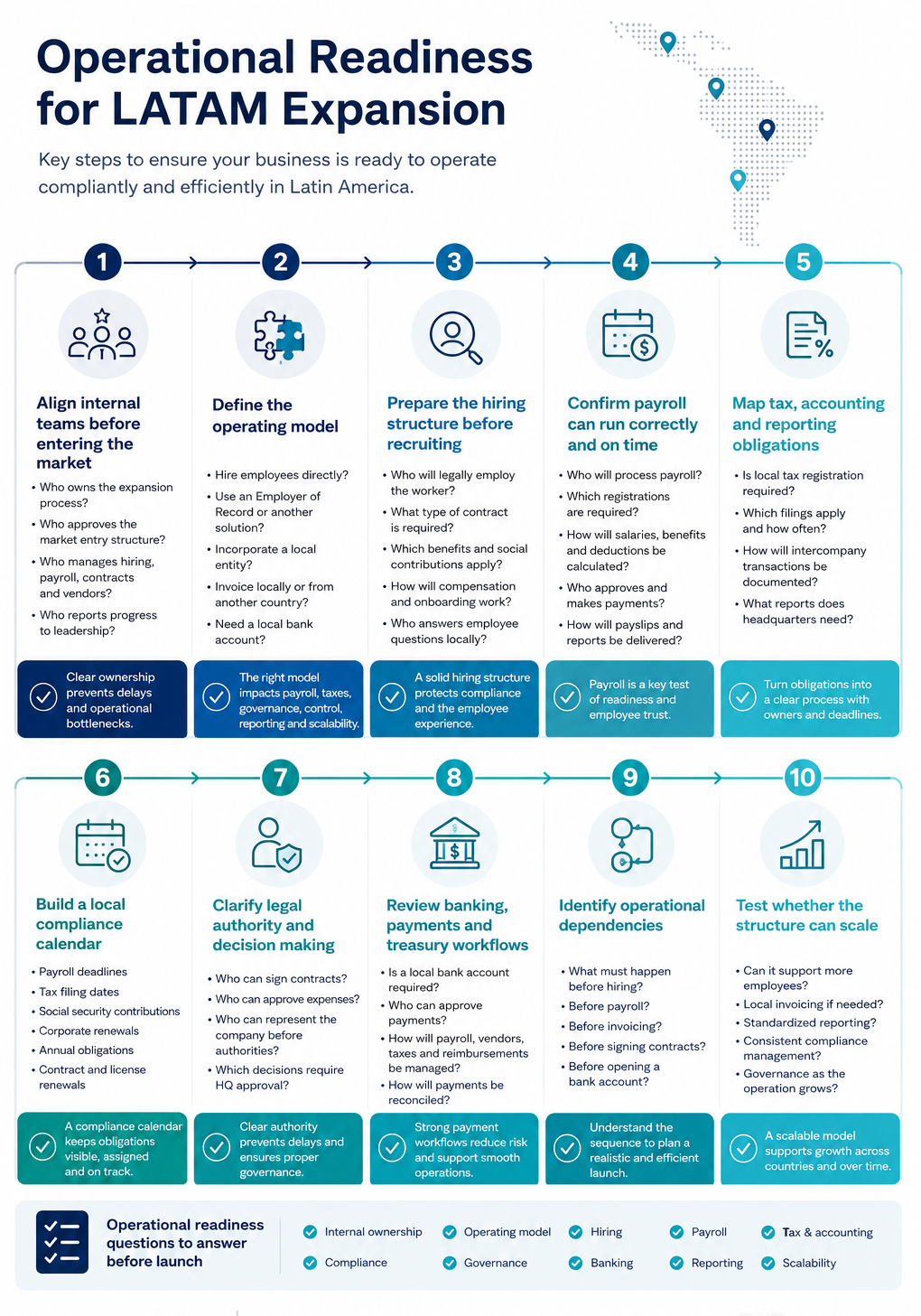
Operational readiness questions to answer before launch
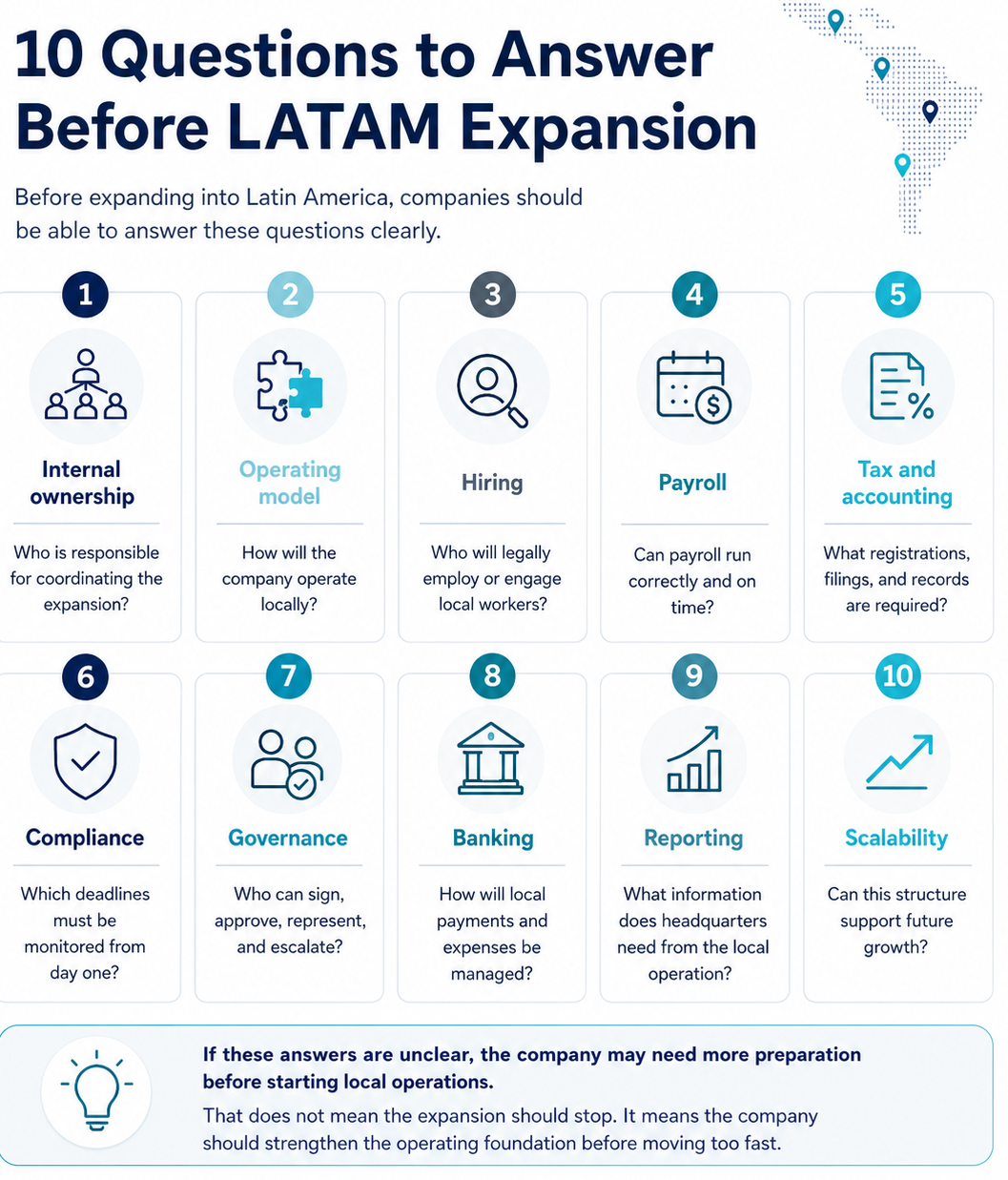
Signs your company may need more operational preparation
A company may need to improve its operational readiness if:
- The employment model has not been defined.
- Payroll responsibilities have not been assigned.
- Local tax obligations have not been reviewed.
- Contract signing authority is unclear.
- No one owns the compliance calendar.
- Banking and payment workflows are still uncertain.
- Headquarters and local teams are not aligned.
- The company is using assumptions from another LATAM country.
- Local reporting requirements have not been mapped.
- The launch timeline does not include administrative dependencies.
These signs are not barriers. They are useful signals. They show where the company should focus before execution becomes more complex.
How Ongresso supports operational readiness in LatAm?
Ongresso helps international companies move from expansion planning to local execution across Latin America. Our team supports companies in evaluating the operational structure needed to enter and operate in the region, including hiring models, payroll, corporate setup, tax and accounting obligations, legal representation, local governance, and compliance coordination.
Because expansion in Latin America requires both regional strategy and country specific execution, Ongresso helps companies understand what can be managed consistently across the region and what must be adapted locally. This gives companies better visibility, stronger coordination, and a more reliable foundation for growth.
Conclusion: make expansion executable
A strong opportunity in Latin America becomes more valuable when the company is ready to operate it.
Before entering a new market, companies should evaluate whether their internal teams, local structure, payroll process, tax obligations, governance rules, banking workflows, reporting needs, and compliance responsibilities are ready to support execution. Operational readiness helps companies turn expansion from a strategic decision into a working business. It gives leadership the clarity to move with confidence, reduce delays, and build a structure that can support sustainable growth across Latin America.
Planning to expand into Latin America?
Ongresso can help you evaluate your operational readiness and build the right structure for compliant regional growth.
FAQ Section