HR Solutions • January 6, 2026 • Written by: Ongresso - Business Beyond Borders

Hiring in Latin America involves significant legal and compliance complexity, especially for international companies expanding across multiple countries. Labor rules, mandatory benefits, payroll registrations, and termination requirements vary by jurisdiction, and even a small error in classification or filings can trigger fines, retroactive payments, audits, and litigation. As enforcement increases, compliance mistakes that might seem minor at first often escalate quickly into financial penalties, legal exposure, and operational disruption that directly affects growth plans.
Even experienced global teams can underestimate how quickly this risk accumulates. The most common issues are not necessarily complex legal disputes, but operational missteps, such as misclassifying workers, overlooking statutory benefits, and applying termination practices designed for other jurisdictions. What makes these errors expensive is that fines and back payments are often calculated using country specific legal units, and they can accumulate per employee and per month, often alongside retroactive obligations. The fastest way to reduce exposure is to combine a consistent governance model with local execution, meaning country compliant contracts, payroll rules, filings, and documentation from day one. In practice, most compliance failures tend to fall into four recurring categories.
The most common legal and compliance errors when hiring in Latin America
1. Misclassification of workers
One of the most frequent and expensive mistakes is treating a worker as an independent contractor when local law considers the relationship to be employment.
In many Latin American countries, the reality of the working relationship prevails over the contract title. If a person works under subordination, fixed schedules, exclusivity, or continuous supervision, authorities may reclassify the relationship as employment.
This reclassification does not only change the worker’s legal status. It typically triggers:
- Retroactive social security contributions
- Payment of statutory benefits
- Penalties, interest, and inspections
- Increased audit and litigation risk
2. Non compliance with mandatory benefits and social contributions
Each country in Latin America has statutory benefits that go far beyond base salary, including social security, health insurance, pension contributions, bonuses, and paid leave.
Failing to comply, even unintentionally, is treated as a serious violation. These obligations are mandatory by law and cannot be waived by private agreement, even if the employee accepted different terms. For international companies unfamiliar with local frameworks, this is one of the most common sources of accumulated financial exposure.
3. Improper termination of employment contracts
Termination rules in Latin America are highly regulated and strongly employee protective. Unlike at will employment systems, terminating an employee without proper cause or procedure often results in mandatory severance payments.
In many cases, a poorly handled termination can cost more than retaining the employee for an additional year, once indemnities, accrued benefits, and potential legal claims are considered.
4. Assuming regional uniformity where none exists
A common strategic mistake is assuming that once compliance is achieved in one country, it applies across the region.
In reality:
- Employment contracts are country specific
- Payroll structures vary significantly
- Reporting obligations differ by jurisdiction
- Enforcement intensity is not uniform
This assumption leads to scalable errors, where the same mistake is repeated across multiple countries, multiplying risk as operations expand.
From compliance mistakes to measurable financial impact
What makes legal and compliance risk particularly challenging in Latin America is that financial exposure accumulates over time. Penalties are often applied per employee, per month of non compliance, with interest and surcharges, and alongside retroactive payments and legal claims.
As a result, similar compliance errors can produce very different financial outcomes depending on the country, the number of employees affected, and the duration of the issue.
The table below summarizes how common labor compliance mistakes translate into real financial exposure across Latin America. Amounts are presented as typical exposure ranges and common penalty formats used in practice, since exact figures can vary by severity, company size, recurrence, and enforcement approach.
Financial impact of common labor compliance errors in Latin America
| Country | Common compliance error | Typical financial impact | Sources |
| Argentina | Registration errors, termination disputes | High litigation exposure, severance and damages exceeding several months of salary. | Ministry of Labor, Employment and Social Security. Labor Contract Law No. 20,744, Article 245, Severance Compensation Regulations. 2024. |
| Bolivia | Failure to register employer or employees | Fixed fines per worker plus inspection penalties. | Ministry of Labor, Employment and Social Welfare. Mandatory Employer Registration Regulation (ROE). 2023. |
| Brazil | Misclassification, unpaid social charges | USD 20,000 to 30,000 plus per case including penalties and interest | Mattos Filho Law Firm. Brazilian Labor Law Reform and Registration Penalties under CLT Article 47. 2023. |
| Chile | Non payment of social security contributions | Fines calculated in UTM, plus interest and employee claims. | Chilean Labor Directorate. Fines and Sanctions for Non-Compliance with Labor and Social Security Obligations. 2024. |
| Colombia | Incorrect termination, unpaid benefits | Retroactive payments and penalties that may exceed 100 percent of owed amounts. | Colombian Ministry of Labor. Labor Sanctions Regime, Fines up to 5,000 Monthly Minimum Legal Wages. 2023. |
| Costa Rica | Failure to include workers in payroll | Penalties equivalent to multiple base salaries per omission. | Ministry of Labor and Social Security. Labor Code, Article 398, Sanctions for Payroll Omission. 2023. |
| Dominican Republic | Failure to register workers in TSS | Fines equivalent to 1 to 6 minimum salaries per employee. | Social Security Treasury (TSS). Resolution on Administrative Sanctions for Affiliation Omissions. 2023. |
| Ecuador | Late or missing contract registration | USD 25 to USD 50 per contract, cumulative fines up to approximately USD 9,000 plus. | Ministry of Labor of Ecuador. Sanctions for Non-Compliance with Employment Contract Registration. 2023. |
| El Salvador | Failure to submit payrolls or contributions | Penalties up to 25 percent of unpaid contributions, plus interest. | Salvadoran Social Security Institute (ISSS). Enforcement and Sanctions Regulation for Employer Contributions. 2023. |
| Guatemala | Late registration with social security | Fixed monetary fines plus surcharges. | Guatemalan Social Security Institute (IGSS). Employer Affiliation Regulation, Late Registration Penalties. 2024. |
| Honduras | Failure to register or insure employees | Retroactive contributions, fines, and inspection penalties. | Honduran Social Security Institute (IHSS). Employer Affiliation and Sanctions Regulation. 2023. |
| Mexico | Worker misclassification, improper termination | USD 5,000 to USD 25,000 plus per employee, plus retroactive benefits and severance. | Holland & Knight. Amendment to Mexico’s Federal Labor Law, Fines for Employer Non-Compliance. 2024. |
| Panama | Non affiliation to social security | USD 100 to USD 5,000 depending on severity and recurrence. | Social Security Fund (CSS). Law 51 of 2005, Article 121, Fines for Failure to Register Employees. 2024. |
| Paraguay | Failure to submit labor notifications or payrolls | Fines ranging from 1 to 20 minimum daily wages per worker. | Ministry of Labor, Employment and Social Security (MTESS). Labor Sanctions Regime. 2024. |
| Peru | Failure to register employees in payroll | Classified as very serious infringement, fines scaled by company size and workers affected. | National Superintendence of Labor Inspection (SUNAFIL). Labor Fines Scale by Type of Infraction and Number of Employees. 2024. |
| Uruguay | Late employee registration or reporting errors | Fines calculated per worker and reporting period. | Social Security Bank (BPS). Sanctions for Non-Compliance with Employee Registration and Reporting Obligations. 2023. |
Why these risks are increasing, not decreasing
Labor enforcement across Latin America is intensifying because authorities now have more digital visibility, and they are increasingly able to cross check employer data across tax, social security, and labor systems.
First, the region’s broader digitization of tax control is expanding beyond invoicing. A joint IDB and CIAT publication explains that electronic invoicing initiatives in Latin America have been extended into other areas of tax control, including payroll and goods in transit, which strengthens the ability to detect inconsistencies tied to employment and compensation reporting.
Second, adoption has scaled materially. CIAT and IDB authors report that the IDB has supported the implementation and strengthening of e invoicing in 17 countries across Latin America, which means a growing share of the region operates with digitally traceable transaction data and stronger audit capabilities.
Third, authorities are consolidating reporting streams to enable cross agency verification. In Brazil, eSocial is designed as a centralized national framework for transmitting HR and payroll related information, and it explicitly consolidates labor, social security, and tax information into a single system, and it makes audits easier because employment related data is transmitted online and stored centrally. In parallel, an IDB case study describing Brazil’s data driven oversight references eSocial as a digital bookkeeping platform used to report tax, social security, and labor obligations data, which illustrates how compliance signals can be connected across obligations rather than reviewed in isolation.
As a result, compliance gaps that once went unnoticed are now detected faster, and penalties are applied more consistently, increasing both financial and operational risk for international companies operating across multiple Latin American jurisdictions.
How Ongresso helps companies avoid legal and compliance exposure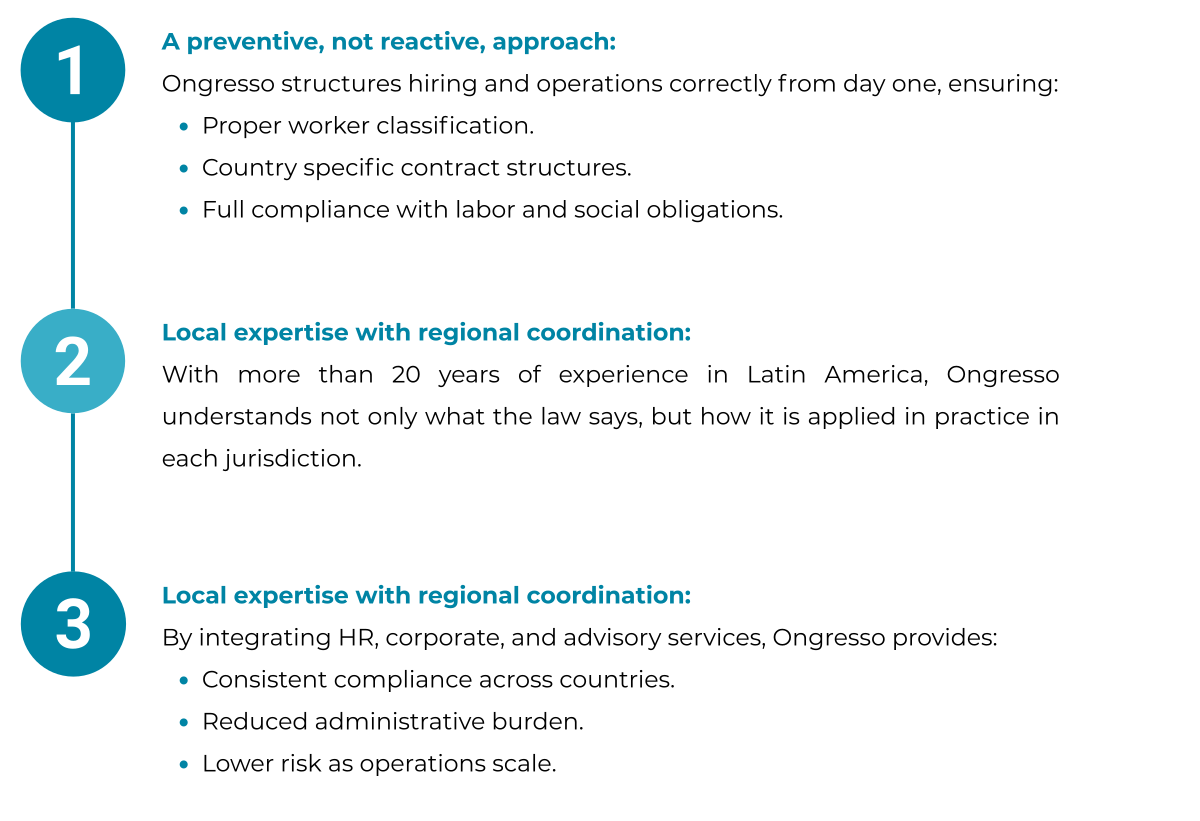
Conclusion: A Structured Process for Secure Expansion
Legal and compliance risk in Latin America is measurable and manageable, but only when it is treated as part of the expansion strategy, not as an administrative task after hiring begins. Because rules vary significantly by country and enforcement is increasingly supported by digital oversight, international companies need a model that combines consistent regional governance with country specific execution, meaning compliant contracts, correct worker classification, payroll and social contributions aligned to local rules, and well documented termination processes. Ongresso supports this approach through its one-stop-shop model and more than 20 years of regional experience, helping companies structure hiring and operations correctly from day one. The result is lower exposure, fewer operational disruptions, and expansion timelines that remain stable as teams scale across Latin America.
Schedule a consultation with Ongresso’s experts to validate your hiring model, reduce legal exposure, and build a compliant, scalable expansion strategy across Latin America.