Company Formation • June 15, 2026 • Written by: Ongresso - Business Beyond Borders
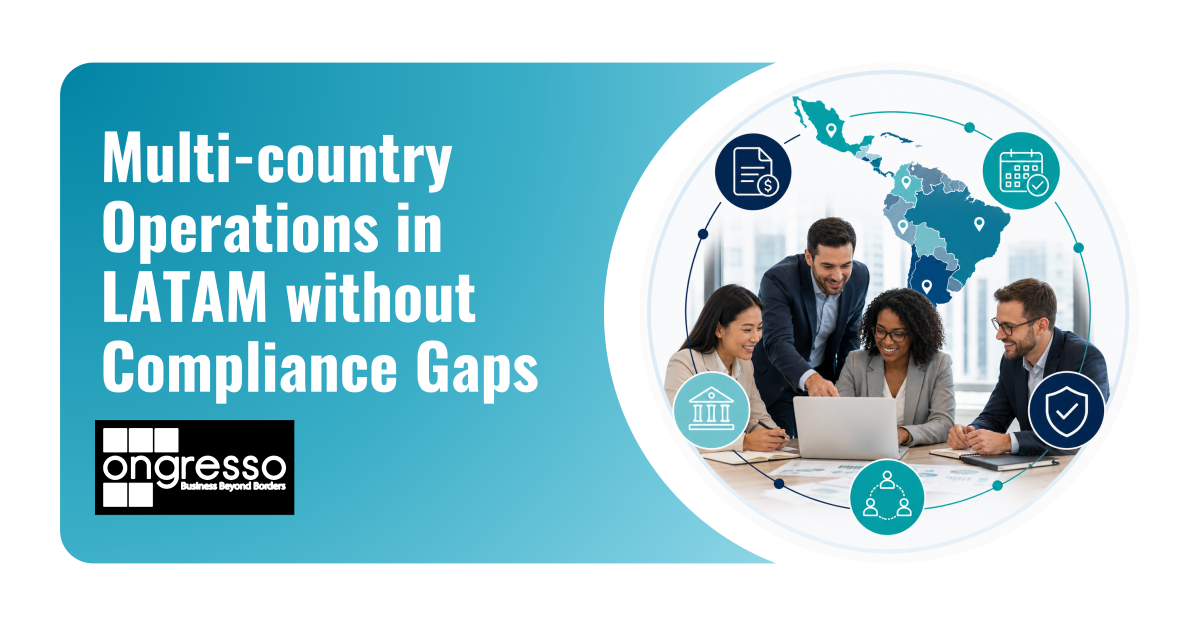
Managing operations across several countries in Latin America can create strong opportunities for international companies. The region offers access to talent, new customers, strategic locations and growing business ecosystems. But operating in more than one country also increases complexity.
Each market has its own labor regulations, payroll rules, tax obligations, reporting deadlines, corporate requirements and administrative procedures. What works in Colombia may not work in Mexico, Brazil, Chile or Peru. For companies expanding across the region, the challenge is not only entering new markets. It is maintaining control as operations become more complex. To manage multi-country operations in Latin America successfully, companies need a regional strategy supported by strong local execution.
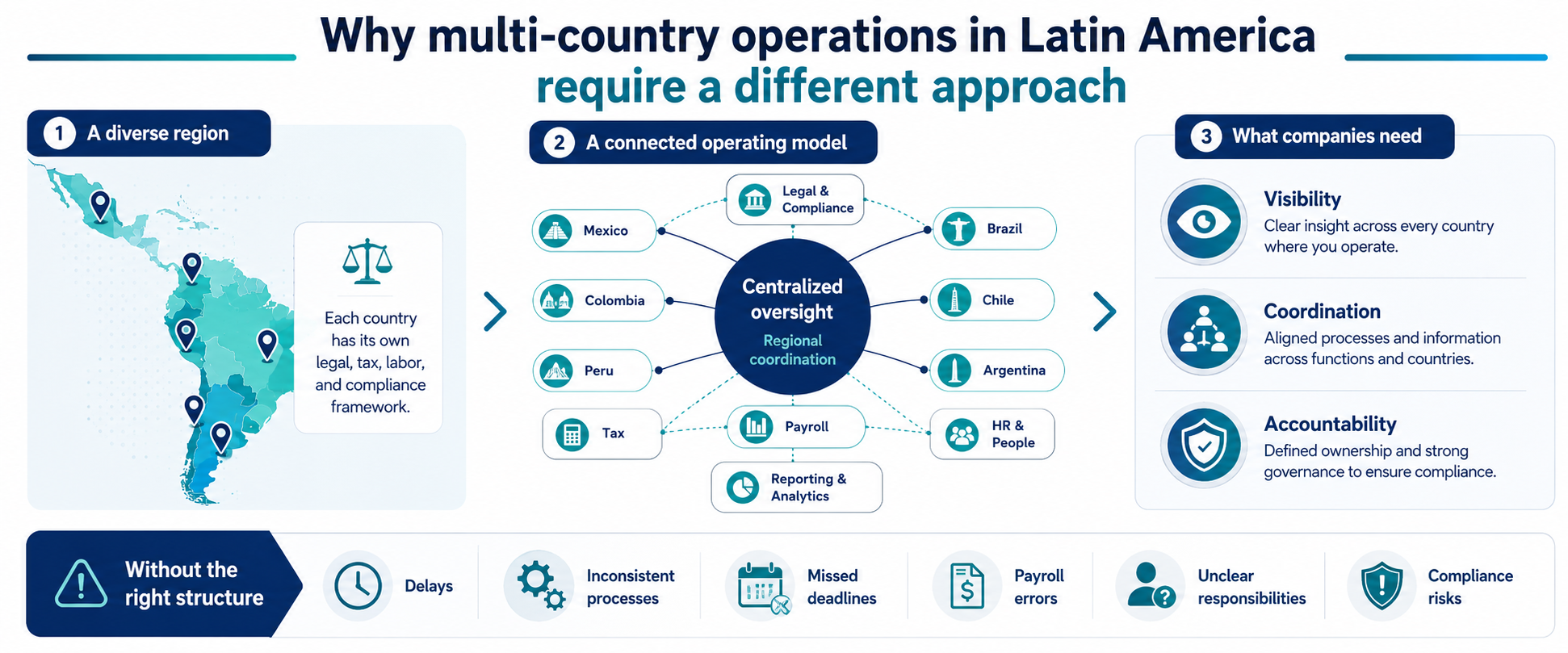
Why multi-country operations in Latin America require a different approach?
Latin America should not be managed as one single market. Although companies often think about the region as a business opportunity, each country operates under its own legal, tax, labor and compliance framework. This means that a company managing teams, entities, vendors or payroll across multiple countries needs more than a general regional plan. It needs a structure that connects local requirements with centralized oversight. Without that structure, companies may face delays, inconsistent processes, missed deadlines, payroll errors, unclear responsibilities and compliance risks.
The goal is not to control everything from headquarters without local input. The goal is to create a model where the company has visibility, coordination and accountability across every country where it operates.
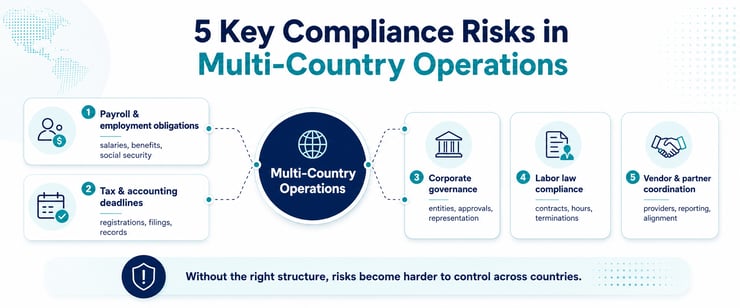
What are the main compliance risks in multi-country operations?
When companies operate in several Latin American countries, compliance risks often appear in areas that seem administrative at first, but can quickly affect the entire business.
1. Payroll and employment obligations. Payroll requirements vary by country. Employers need to manage salaries, benefits, social security contributions, tax withholdings, bonuses, paid leave and statutory payments according to local rules. A small payroll mistake can create employee dissatisfaction, penalties or reporting issues. When this happens across several countries, the risk becomes harder to track.
2. Tax and accounting deadlines. Each country has different tax registrations, filing calendars, accounting records and documentation requirements. Companies need to know which obligations apply, who is responsible and when each deadline must be completed. Without a clear calendar, tax compliance can become reactive instead of controlled.
3. Corporate governance. Multi-country operations often involve local entities, legal representatives, directors, powers of attorney, bank accounts and approval processes. If governance is not clearly defined, companies may face bottlenecks when signing documents, approving payments, responding to authorities or escalating urgent matters.
4. Labor law compliance. Employment contracts, working hours, termination rules, benefits, leave policies and employee classifications differ across the region. A policy created for one country may not be legally valid in another. Companies need local adaptation without losing regional consistency.
5. Vendor and partner coordination. As companies grow across Latin America, they often work with different providers in each country. This can create fragmented communication, duplicated work and inconsistent reporting. A regional operating model helps ensure that local partners work under the same standards and that headquarters has a clear view of what is happening.
How can companies keep compliance control across LatAm?
Companies can manage multi-country operations more effectively by combining regional coordination with local expertise. The following practices help reduce risk and improve visibility.
1. Build a centralized compliance calendar. A compliance calendar helps companies track payroll dates, tax filings, corporate renewals, accounting deadlines, statutory reports and labor obligations across each country.
This calendar should include:
- Country
- Obligation
- Responsible person or provider
- Deadline
- Required documents
- Status
- Escalation contact
The value of a compliance calendar is not only organization. It creates visibility and reduces the risk of missed deadlines.
2. Define local responsibilities clearly. Every country needs clear ownership. Companies should know who is responsible for payroll, tax filings, employee documentation, corporate records, legal representation and communication with local authorities.
When responsibilities are unclear, teams lose time deciding who should act. In compliance matters, that delay can become expensive. A strong operating model defines what is managed locally, what is reviewed regionally and what requires headquarters approval.
3. Standardize processes, but adapt them locally. Standardization is important, but it should not ignore country-specific requirements. For example, a company can have one regional onboarding process, but the employment contract, benefit registration and payroll documentation must follow local rules. The same applies to offboarding, accounting, tax reporting and corporate governance. The best approach is to create regional templates with local adaptations. This allows companies to maintain consistency while respecting each country’s legal framework.
4. Use reliable local data for decision-making. Companies often lose compliance control when they make decisions based on assumptions. Before hiring, opening an entity, signing a contract or changing an operating model, companies should validate local requirements.
This includes understanding:
- Employment costs
- Mandatory benefits
- Payroll taxes
- Entity requirements
- Tax registrations
- Local reporting obligations
- Timelines for implementation
- Risks related to misclassification or non-compliance
Reliable local information helps companies avoid decisions that seem efficient at the beginning but create problems later.
5. Create one regional reporting structure. When each country reports information differently, headquarters may struggle to understand the real status of operations.
A regional reporting structure helps consolidate updates across countries. This can include payroll status, employee headcount, tax filings, compliance deadlines, open issues, pending approvals and upcoming risks. The reporting structure does not need to be complex. It needs to be consistent.
6. Review the operating model as the company grows. The right model for entering a market may not be the right model for long-term operations.
Some companies begin with an Employer of Record to hire their first employees. Others open a local entity from the beginning. Over time, the company may need to adjust its structure based on team size, commercial activity, tax exposure, local contracts and long-term strategy. Compliance control depends on reviewing these decisions regularly. What worked during market entry may need to evolve as the business grows.
7. Work with a regional partner that understands local execution. A regional partner can help companies coordinate multi-country operations with more clarity. Instead of managing disconnected providers in each country, companies can work with a partner that understands both the regional strategy and the local requirements.
This is especially valuable when the company needs support with HR, payroll, corporate services, accounting, tax, legal representation or compliance monitoring across different Latin American markets.
How Ongresso supports multi-country operations in Latin America?
At Ongresso, we support international companies that want to expand, operate and grow in Latin America without losing compliance control. We work as a regional partner with local execution, helping companies coordinate HR, corporate and advisory needs across different markets. Our support can include payroll, Employer of Record, PEO, recruiting, company formation, legal representation, accounting, tax, annual compliance and market advisory services.
For companies managing operations in more than one country, our role is to help create structure, visibility and coordination. We help companies understand what needs to happen locally, how to organize responsibilities and how to keep regional operations aligned.
Conclusion
Managing multi-country operations in Latin America requires more than expansion ambition. It requires structure, visibility and local compliance control. Companies that operate across several markets need to understand each country’s requirements while maintaining a regional view of responsibilities, deadlines and risks. With the right operating model and local support, companies can grow across Latin America without losing control of payroll, tax, HR, corporate governance and compliance obligations.
For international companies, the key is not only to expand across the region. It is to build a coordinated operation that can scale with confidence.
FAQs