The EU Approved the Mercosur Trade Agreement: Strategic Implications for Companies Operating Across Europe and Latin America
Governance Regulation • January 13, 2026 • Written by: Ongresso - Business Beyond Borders
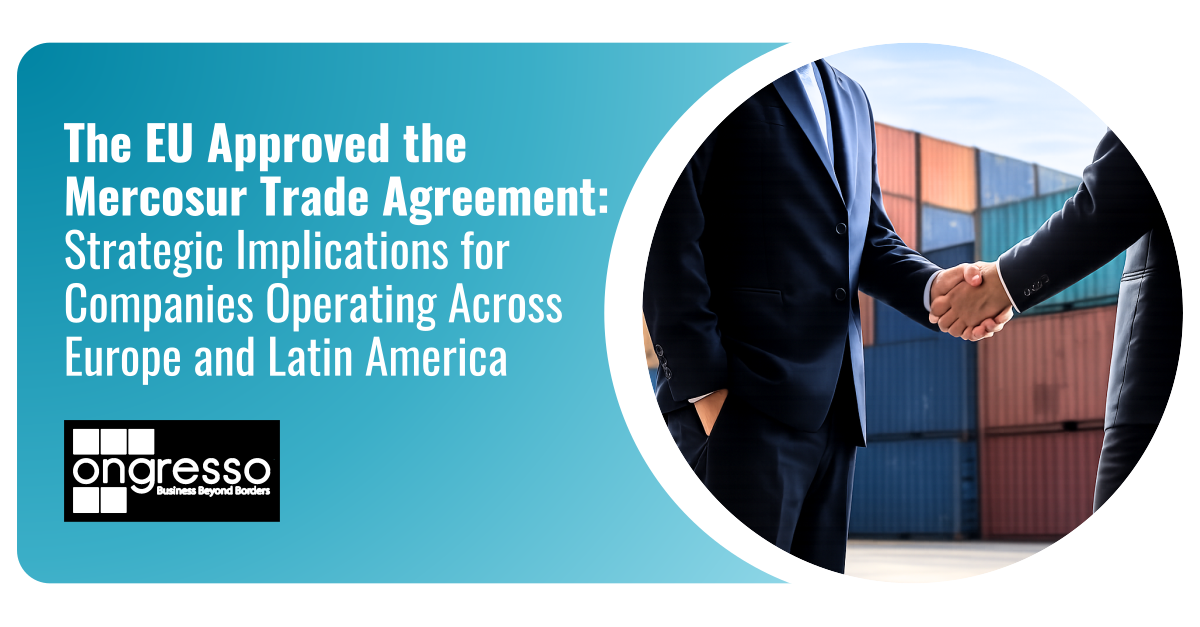
On January 9, 2026, the Council of the European Union approved, by qualified majority, the signature of the trade agreement between the European Union, EU, and the Mercosur bloc, comprised of Argentina, Brazil, Paraguay, and Uruguay, marking a meaningful milestone in a negotiation that has extended for more than 25 years (Aduananews). This agreement lays the groundwork for one of the largest free trade areas globally, with a potential market of more than 700 million consumers and a historically significant level of exchange between both regions (Aduananews).
It is important to consider that this political approval requires time before the treaty can take effect, since legal and operational impact depends on the agreement being formally signed and then ratified by the European Parliament and by the national legislatures of Mercosur countries (The Brussels Times). Therefore, for companies that already operate, or plan to expand, across Europe and Latin America, this development is both political and strategic, especially as it reshapes the future framework for market access, trade in services, investment, and regulatory compliance.
What was approved, and what comes next?
The Council of the EU authorized the signature of two key instruments. First, the EU Mercosur Association Agreement, which includes trade, cooperation, and political dialogue. Second, the Interim Trade Agreement, designed to advance the trade component while the institutional process continues (Council of the EU).
According to official information, the treaty includes the progressive elimination of more than 90% of tariffs on goods and services between both blocs, as well as expanded access for sectors such as automotive, machinery, chemicals, pharmaceuticals, telecommunications, and financial services (Spain’s Ministry of Industry, Trade and Tourism). In addition, this step reflects an EU strategy aimed at diversifying commercial relationships and strengthening more resilient supply chains, within a global context shaped by geopolitical tensions and shifting trade flows (Aduananews).
Key implications for international companies
1. Expanded market access and cost optimization
Gradual tariff reduction creates concrete opportunities for companies exporting goods and services between both regions, particularly in industries where final price and logistical efficiency are decisive competitiveness factors (Spain’s Ministry of Industry, Trade and Tourism). As a result, it becomes valuable to review market entry models, cost structures, and supply chains, since value is captured when operations are adjusted intentionally, not only when the external environment changes.
2. Stronger integration of services and investment
The agreement is not limited to trade in goods. It also supports the liberalization of services and foreign investment, expanding opportunities for companies in sectors such as technology, consulting, logistics, financial services, and broader business solutions (The Brussels Times). Consequently, operating with a consistent regional model becomes more important, allowing companies to adapt to local frameworks while maintaining global coherence, especially when expansion happens in parallel across multiple countries.
3. Compliance, safeguards, and risk management
The treaty includes safeguard mechanisms and sector specific provisions, particularly for sensitive areas such as agriculture, as well as technical standards and certification requirements that must be managed rigorously (Spain’s Ministry of Industry, Trade and Tourism). In practice, this means monitoring regulatory changes across multiple jurisdictions, adjusting compliance and reporting processes, and preparing operations for transition scenarios during the agreement’s progressive implementation.
From political decision to business execution
The Council of the EU’s approval represents the start of an implementation phase that includes the formal signature of the treaty and the ratification processes in Europe and Mercosur, which may extend for several months or years (DatamarNews). This period before entry into force creates a strategic window for companies to refine planning, set investment priorities, and prepare operational structures for the new commercial framework, strengthening execution readiness as the environment becomes fully active.
How Ongresso supports this new scenario
| Ongresso capability | How we support you |
| Strategy and planning |
We define priorities by country, structure the expansion roadmap, and align the operating model with commercial goals and risk criteria. |
| HR Solutions and international talent management |
We build the regional hiring plan, execute processes aligned with local regulation, and ensure consistency in roles, compensation, and operations across countries. |
| Corporate Services |
We design and support the corporate structure required to operate, standardize key administrative processes, and strengthen the compliance foundation from day one. |
| Advisory and regional coordination |
We coordinate regional execution to reduce fragmentation, connect teams and vendors, and maintain visibility and operational control as expansion progresses. |
Conclusion: an opportunity that requires strategic preparation
The approval of the EU Mercosur agreement marks a turning point in the commercial relationship between Europe and Latin America. However, beyond market size or headlines, the real impact will depend on how effectively companies translate this new framework into operational decisions that create sustainable competitive advantages, through disciplined planning, clear priorities, and execution aligned with the region’s regulatory complexity.
The Council of the EU’s January 9, 2026 approval is a tangible milestone in that process. For global companies, it is not only a political signal, it is a practical invitation to prepare now, because the most valuable changes do not happen on announcement day. They happen when organizations turn context into operating reality, aligning strategy, talent, and compliance country by country.
If your company is evaluating expansion, regional hiring, or operational restructuring in Latin America, Ongresso can help you design and execute a consistent plan, country by country, with compliance and speed.