Company Formation • June 21, 2026 • Written by: Ongresso - Business Beyond Borders
Regional operations in Latin America: How to coordinate legal, HR, payroll and finance teams
Latin America continues to attract international companies looking for new markets, specialized talent, nearshoring opportunities and long-term regional growth. In 2024, foreign direct investment inflows to Latin America and the Caribbean reached USD 188.962 billion, a 7.1% increase from 2023, according to ECLAC. This interest confirms the region’s potential, but it also shows why expansion requires more than a commercial plan. Companies entering Latin America need a clear way to coordinate legal, HR, payroll and finance teams from the beginning.
For many international companies, the real challenge starts after the decision to enter the region has already been made. The company may have a target country, a hiring plan and a market opportunity, but the operational structure still needs to work in practice.
-
Who will legally employ local workers?
-
How will payroll be calculated?
-
Which contracts are required?
-
Who manages compliance deadlines?
-
How will finance track local costs?
-
Who reports risks back to headquarters?
These questions cannot be answered separately. In Latin America, legal, HR, payroll and finance decisions are connected. When teams work without coordination, expansion becomes slower, more expensive and harder to control. When these functions work as one system, companies can operate with more clarity, compliance and confidence.
Why regional coordination matters in Latin America?
Latin America is not one single operating environment. Each country has its own labor laws, tax rules, payroll obligations, social security systems, corporate requirements and reporting deadlines. A process that works in Colombia may not work the same way in Mexico, Brazil, Chile or Peru. This is why companies should avoid managing Latin America as if it were one market with the same legal and administrative rules.
The World Bank’s Business Ready 2025 report highlights how regulatory frameworks, public services and operational efficiency affect the business environment for companies. This is especially relevant for international businesses entering Latin America, where local requirements can directly impact hiring, compliance, payroll and corporate operations.
For companies expanding into the region, regional coordination means creating a structure where headquarters, local teams and external partners work with shared information, clear responsibilities and aligned timelines. This is not about adding unnecessary complexity. It is about preventing operational surprises.
The four teams that need to work together
Regional operations in Latin America usually depend on four core functions: legal, HR, payroll and finance.
Each team has a specific role, but none of them can operate in isolation. A hiring decision affects contracts, payroll, social security, accounting and tax. A company formation decision affects bank accounts, legal representation, finance reporting and employee management. That is why coordination should begin before the first hire, first invoice or first local registration.
Legal: Defining the right operating structure. Legal teams are responsible for defining how the company will operate in each country. This can include company formation, legal representation, contracts, governance, local registrations, corporate secretarial obligations and compliance exposure. This step is essential because every operating decision has legal consequences.
For example, if a company wants to hire employees in Colombia, Mexico or Chile, it first needs to define whether it will use an Employer of Record model, a PEO model, contractor arrangements or a local entity. Each option has different implications.
An Employer of Record can help companies hire talent without opening a local entity. A PEO model may support companies that already have an entity but need help managing HR and payroll administration. A local entity may be the right choice when the company has a long-term plan, a larger team or direct commercial operations in the country. The right model depends on the company’s timeline, headcount, risk tolerance, budget and growth strategy.
At this stage, legal should not work alone. HR needs to understand how the selected model affects employees. Payroll needs to know how salaries and contributions will be processed. Finance needs to understand the cost and reporting implications.
HR: Turning expansion plans into local workforce execution. HR teams are responsible for making the people strategy work in each country. This includes recruitment, onboarding, employment documentation, compensation alignment, benefits, employee communication and ongoing HR administration.
In Latin America, HR decisions are closely connected to local compliance. Employment contracts, statutory benefits, probation periods, working hours, paid leave, terminations and documentation requirements vary from country to country. This means that a global HR policy may provide direction, but it must be adapted locally. For example, the way a company structures benefits in Mexico may not be the same as in Colombia. Payroll cycles, mandatory contributions and employment documentation can also vary significantly.
This is especially important in a region where informality remains a structural labor challenge. According to the OECD, for a broader group of 27 Latin American and Caribbean countries, 55% of workers are in informal employment. For international companies, this reinforces the importance of formal, compliant hiring models and accurate workforce administration. A strong HR function should not only ask: who do we need to hire? It should also ask: what is the safest, most compliant and most scalable way to employ this person in this country?
Payroll: Converting compliance into monthly discipline. Payroll is where many operational risks become visible. Salary calculations, tax withholdings, employer contributions, social security payments, statutory benefits, bonuses, exchange-rate considerations and reporting deadlines must be managed accurately and on time. In regional operations, payroll becomes the bridge between HR, legal and finance. HR provides employee data, legal confirms the employment framework, and finance validates cost allocation, payment flows and accounting treatment. Payroll brings all of this together in a recurring monthly process.
When payroll is not integrated with the rest of the operation, mistakes can happen quickly. A compensation change may not be reflected on time. A benefit may be miscalculated. A country deadline may be missed. Finance may receive incomplete cost information. This is why payroll should not be treated as a final administrative step. It should be included in expansion planning from the beginning.
Finance: Maintaining visibility, control and decision-making. Finance teams need reliable information to manage budgets, local expenses, tax obligations, cash flow, accounting records and management reporting.
When a company expands into Latin America, finance needs to understand how local operations affect the broader business. This includes payroll costs, employer contributions, taxes, vendor payments, banking requirements, statutory filings, entity maintenance and intercompany transactions. Without proper coordination, headquarters may receive financial information without enough local context. This can make it harder to understand real operating costs, forecast future expenses or compare performance across countries. With the right structure, finance can support better decisions about when to hire, when to incorporate, when to expand into another country and how to manage regional growth.
Common coordination gaps in Latin America
%2010.03.53%20a.m..png?width=1752&height=1106&name=Captura%20de%20pantalla%202026-06-21%20a%20la(s)%2010.03.53%20a.m..png)
What a regional operating model should include?
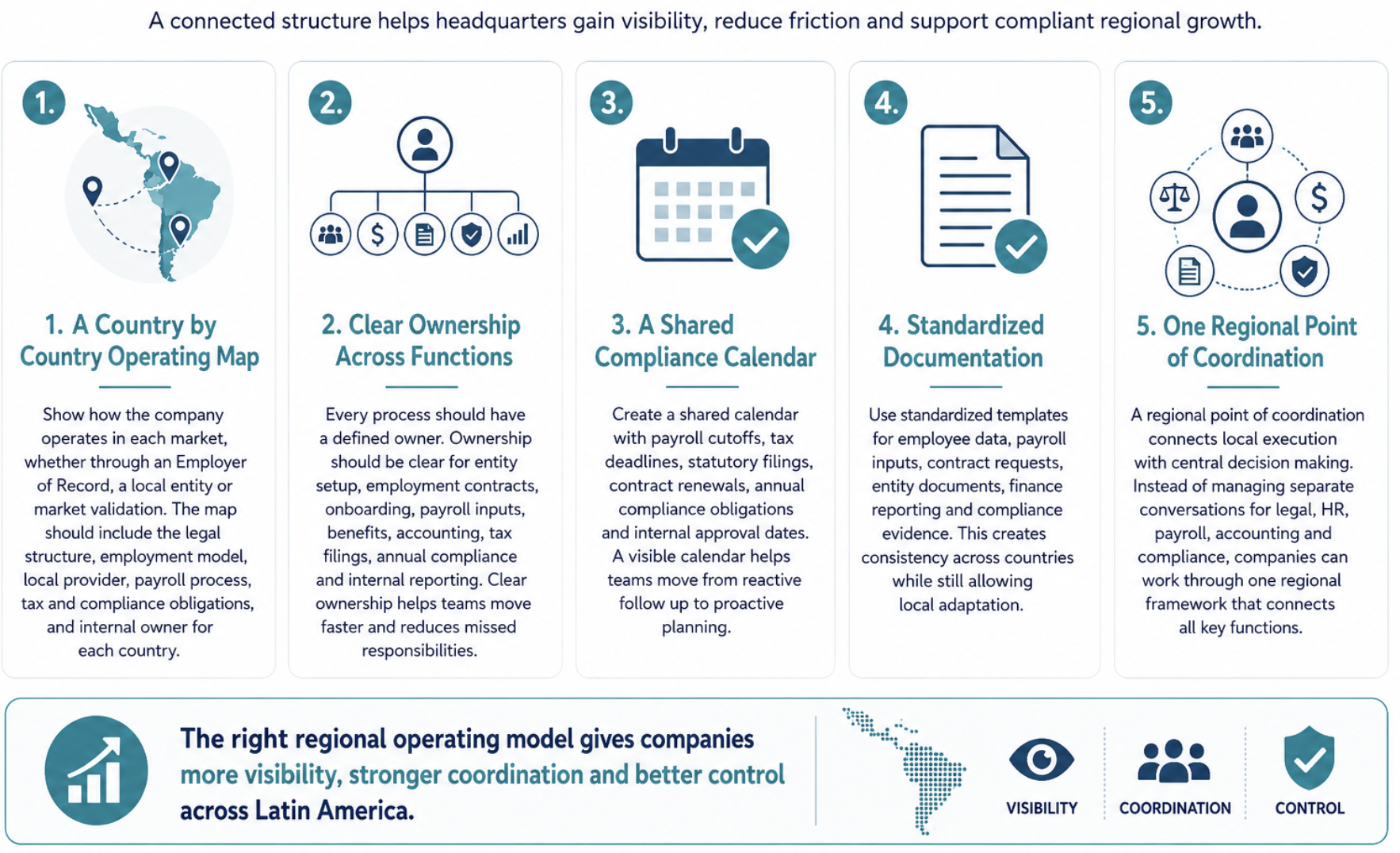
A regional operating model does not need to be complicated. The best models are practical, visible and easy to use. For international companies expanding into Latin America, the model should include five core elements.
How to Coordinate legal, HR, payroll and finance in practice
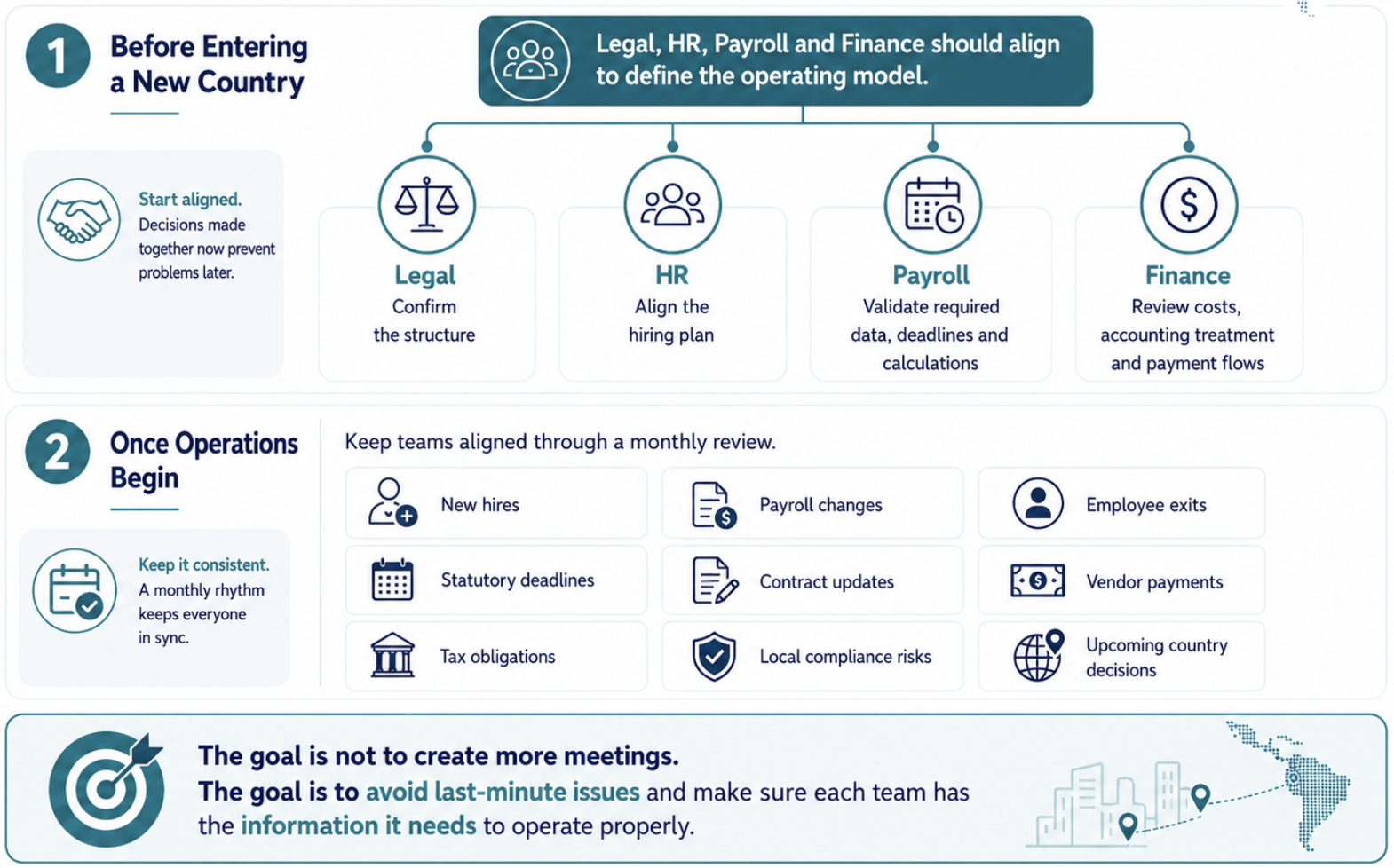
The best starting point is not a large transformation project. It is a practical coordination rhythm. Before entering a new country, legal, HR, payroll and finance should meet to define the operating model.
When should a company centralize regional operations?
A company should consider centralizing regional operations when it is operating in more than one Latin American country, planning to hire across multiple markets, managing several local providers or struggling to maintain visibility over compliance, payroll and finance processes.
Centralization does not mean ignoring local requirements. It means creating one structure that makes local execution easier to manage. For example, a company expanding into Colombia, Mexico and Chile may still need country-specific contracts, payroll calculations and tax support. But it can manage those processes through one regional framework, one reporting structure and one coordination partner. That is the difference between expanding country by country and building a scalable Latin America operation.
How Ongresso supports regional operations in LatAm?
Ongresso helps international companies coordinate legal, HR, payroll, corporate and finance-related processes across Latin America. For companies entering the region, this support can include Employer of Record and PEO solutions, recruitment, payroll administration, company formation, legal representation, accounting, tax, treasury, annual compliance and corporate secretarial services.This integrated approach is especially useful for companies that need local expertise but do not want to manage multiple disconnected providers in each country.
Instead of treating legal, HR, payroll and finance as separate workstreams, Ongresso helps companies connect these functions under one regional operating model. This gives headquarters better visibility, improves local execution and supports more compliant growth across the region.
Conclusion
Building regional operations in Latin America requires more than entering the right market. It requires a structure that allows teams to make decisions with the same information, the same priorities and a clear understanding of local requirements.
For international companies, legal, HR, payroll and finance cannot work as separate tracks. Each function affects the others, from the way a company hires and pays employees to how it manages compliance, costs, reporting and local obligations. When these teams are aligned, expansion becomes easier to manage. Companies gain better visibility, reduce operational gaps and create a more reliable foundation for growth across the region.
Latin America offers strong opportunities for companies looking to expand, hire and build long-term operations. The companies that are better prepared are the ones that coordinate early, define ownership clearly and build an operating model that can grow with them country by country.
Need support coordinating operations across LatAm?
Ongresso helps international companies connect legal, HR, payroll, corporate and finance processes through one regional partner.
If your company is planning to hire, operate or expand across Latin America, our team can help you define the right structure and coordinate the key functions needed for compliant regional growth. Speak with an expansion specialist and build a clearer path for your Latin America operations.
FAQs